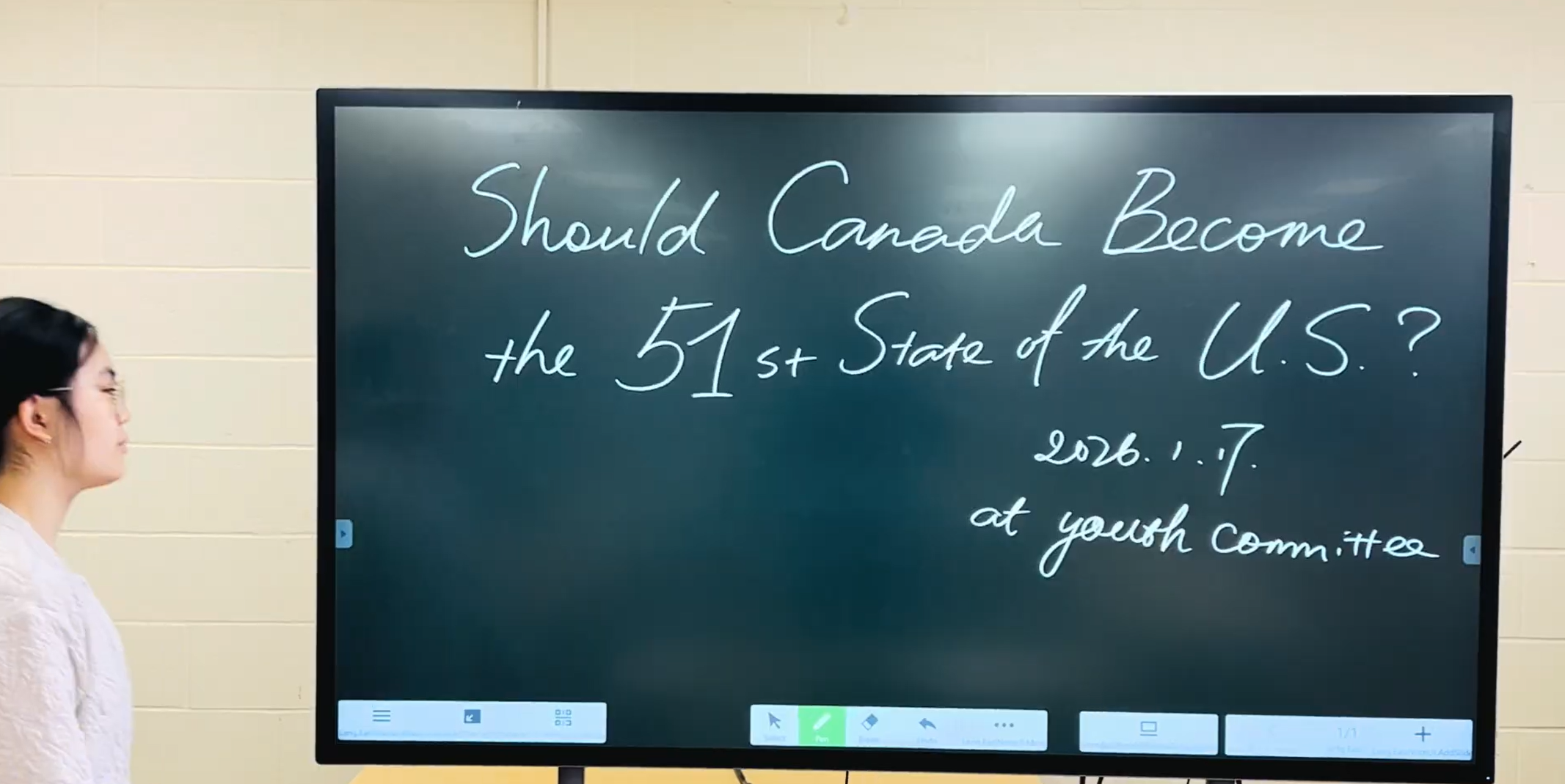
“Should Canada become the 51st state of the United States?”
On January 18, 2026, to mark the beginning of the new year, VLA hosted its very first debate.
The motion under discussion was:
“Should Canada become the 51st state of the United States?”
Participants were divided into two teams: the Proposition (supporting the motion) and the Opposition (opposing the motion).
The Proposition team consisted of Mandy, Celine, Wendy, Judy, and Terra, while the Opposition team was formed by David, Frank, Michael, Yuki, Lisa, and Chelsea.
Video editor: Terra Liu. She is a Grade 7 student in Heritage Glen Elementary School
One week prior to the debate, the motion was officially announced. Teams were quickly formed, roles clarified, and all participants were encouraged to conduct independent research and contribute meaningfully to their team’s strategy. Throughout the week, both sides held multiple discussions, refining arguments, anticipating rebuttals, and preparing for a rigorous exchange. No team was willing to concede without a fight.
On the day of the debate, January 18, participants arrived well-prepared and highly focused. Nearly twenty minutes before the session began, both teams could be seen finalizing strategies, clarifying roles, and exchanging last-minute insights—an intense prelude to the debate ahead.
Once preparations concluded, the chair, Wenqi, called the room to order and announced that the Proposition team would deliver the opening statement.
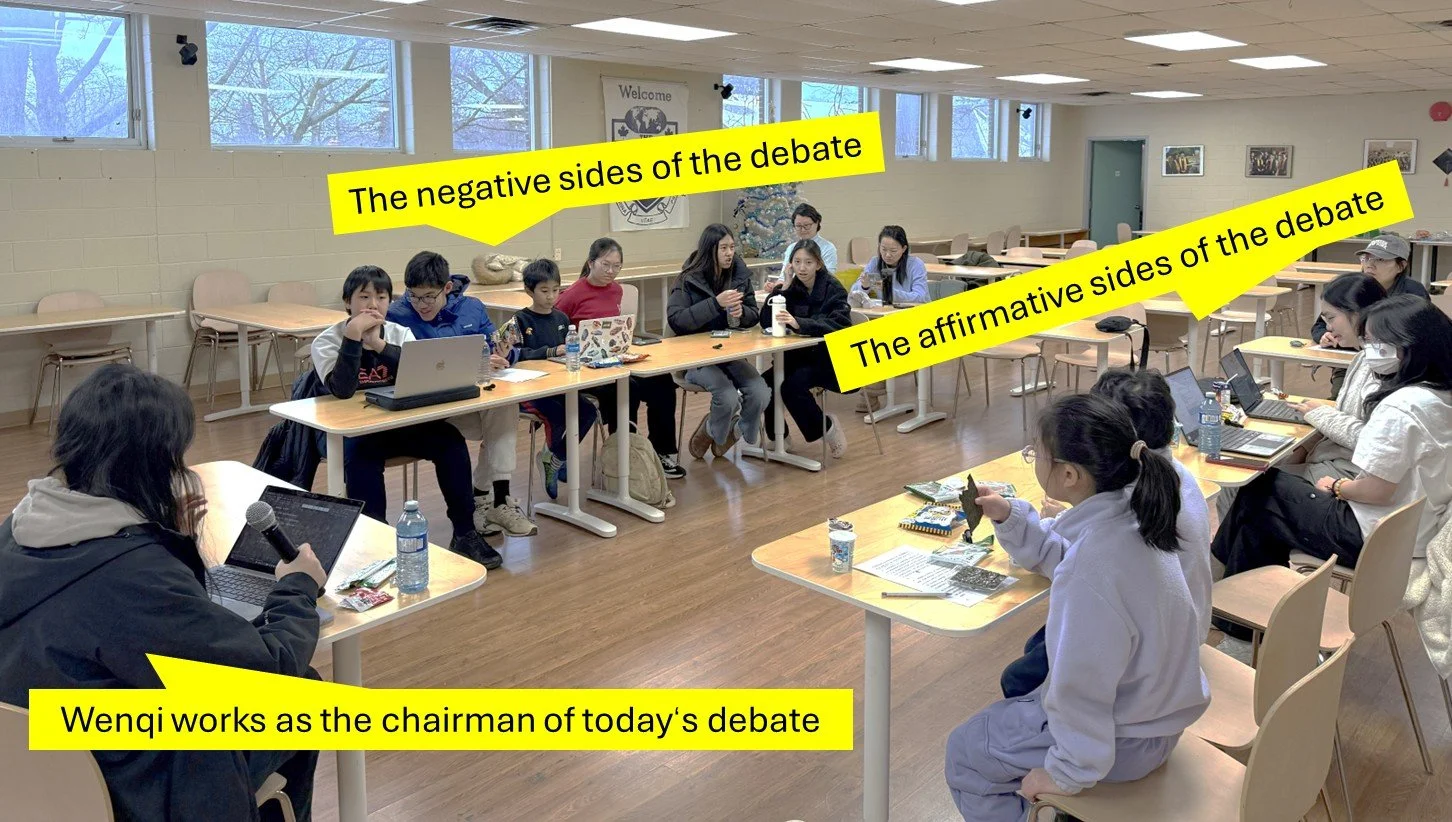
The Proposition team began by outlining the political, economic, and security advantages that Canada might gain by joining the United States. Their argument was clearly structured, confidently delivered, and supported by evidence, making it difficult to refute.
In response, the Opposition team emphasized the risks associated with such a move, particularly the loss of sovereignty, long-term political autonomy, and national control. They argued that these consequences far outweighed any short-term benefits, presenting a principled and forward-looking counterargument.
Determined to establish a decisive advantage early on, the Proposition team followed with a forceful rebuttal, citing researched data to reinforce their claim that the benefits clearly surpassed the costs. The strength and clarity of this response momentarily unsettled the Opposition.
At this critical moment, Frank, a member of the Opposition team, stepped forward to defend his side. He delivered a passionate and articulate response that challenged the assumptions behind the Proposition’s projections. What followed was a sustained exchange between Frank and two of the most experienced debaters on the Proposition team, Mandy and Celine.
Despite limited experience and comparatively less preparation, Frank demonstrated remarkable composure, resilience, and speaking ability. Time and again, he responded effectively to counterarguments, pushing the debate across a wide range of issues—from short-term gains versus long-term risks, to national security, international relations, and even the hypothetical possibility of Canada developing its own nuclear weapons. Throughout this exchange, the audience followed the discussion with interest.
Nevertheless, as compelling as individual performance may be, a lack of preparation, coordination, and teamwork inevitably takes its toll.
After fifteen minutes of intense debate, the judge brought the session to a close. The adults present—serving as the jury—withdrew to deliberate on the outcome and to select both the winning team and the most outstanding debater.
After several minutes, the jury returned with their decision: the Proposition team was declared the winner, and Frank was awarded the title of Most Outstanding Debater.
The announcement was met with enthusiastic applause. Both teams reflected on their performance as Ms. Jinlu offered constructive feedback, highlighting areas for improvement in preparation, participation, and delivery—insights that prompted thoughtful reflection among all participants.
With concluding remarks delivered and the session formally closed, the debate came to an end. Participants left both mentally exhausted and deeply satisfied, carrying with them the experience of a challenging, engaging, and memorable first debate at VLA.
Author Frank:
Frank Ding is a grade 8 student in Pilgrim Wood Public School. He enjoys Stephen Hawking's A Brief History of Time, exploring topics related to quantum computing, playing basketball, and walking the dogs in his family.
